Optimising 1:1s
I’ve spoken with a few folks about 1:1s recently. What’s the right cadence? What’s the right tool to track them? How do I know if I’m doing them well? With the recent opening of Babylon’s new East London office and now finding my team split across two locations it’s been a good moment to reflect on what’s working and how I want to tweak 1:1s with direct reports moving forward. There are tons of great posts with guidance on this topic, but here a few thoughts and tactics I’ve found to be useful:
- Prioritise human connection. Dedicated apps or pre-packaged agendas sound great in theory and can definitely work well for certain people, but I’ve found ‘whatever best helps me connect with this human’ to be my guiding principle when evaluating whether to introduce a new tool or technique. This often results in leaving my laptop behind to be fully present in 1:1s. I’ve also recently learned the joys of walking 1:1s, which pretty much forces you to not take notes while you’re together, (and instead reflect on the conversation afterwards).
- Name with intent. I used to follow the classic ‘Tom:Hannah’ calendar naming format; it’s practical, efficient and descriptive, what’s not to like? This is fine if you’re meeting a peer, but I’ve found 1:1s with direct reports naturally default to DRs providing status updates on projects unless you’re constantly re-framing the conversation to be about the individual, and ultimately, what support they need for growth. I now use ‘✨ Hannah time’ as the weekly reminder name. It’s a bit cheesy but it re-enforces the focus of these conversations and helps shift the emphasis toward DRs leading the agenda. The emoji also helps me scan my calendar and see where my most important meetings are.
- Reflect regularly. While at BuzzFeed I recall Cap telling me how he prepared for annual reviews year-round by blocking out time each month to write about each of his direct reports, the progress they’re making and feedback he’d noticed. Smart! But being the nerd that I am, a simple text document felt too unconstrained so I took this idea and built a spreadsheet template that captured mood (through emojis of course), whether I’d given DRs praise or critique and lightweight notes where relevant. I attempted, but often failed, to update it every week. It was great at highlighting patterns in where I was focusing my attention and current team health, but I also realized it was too constrained for the nuances of individual growth paths and didn’t account well for new starters vs people I’d been working with for years. Since joining Babylon I’ve simplified the template (shown below). Each direct report has a column, and each week is a row. There’s enough room to write a couple of sentences and enough constraint to update it regularly. I’ve found these regular reflections — in whatever form they take — to be invaluable as part of any review cycle.
- Solicit timely peer feedback. If a direct report has done some good/bad work recently, and you’ve already given them this feedback directly, speak to their peers now, don’t wait for a review cycle. What was so good/bad? Why? What’s unique to the way this person tackled the problem that you wouldn’t have gotten from a random freelancer? Asking these questions when they’re fresh in people’s heads gives them the best chance of remembering what happened, and not just the practical details but the emotional qualities in the way it made the team feel. I try to bring a detective mindset, identifying opportunities to examine things like project launches, workshop successes & failures and conflict on the team to understand a more holistic picture of what happened through multiple perspectives.
- Face-to-face every week. Wherever possible, I spend 30 minutes talking 1:1 with direct reports about non-status-update-related-things every week. Due to the location constraint mentioned earlier this has become a real challenge recently but the value in meeting regularly in person is always worth it, particularly in a fast-moving and constantly changing environment.
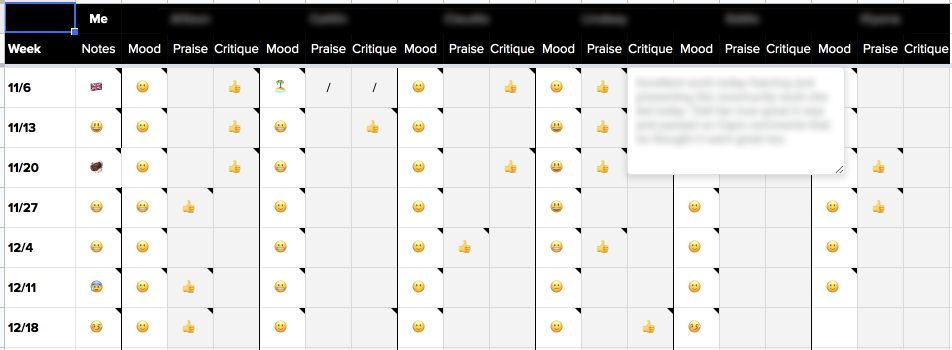
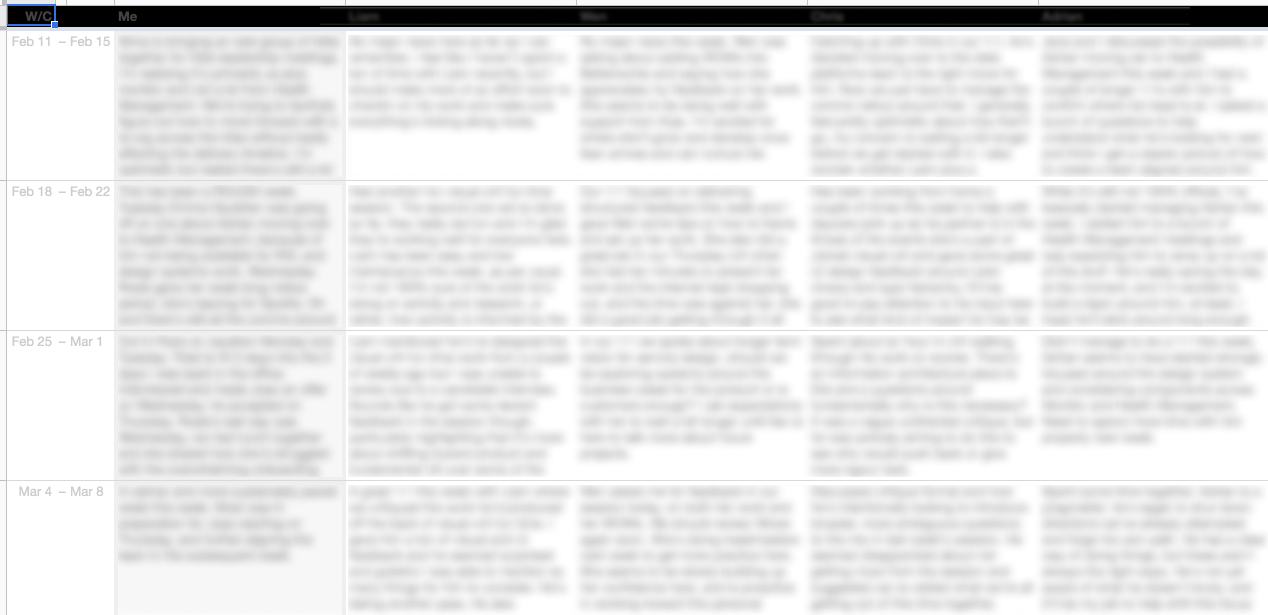
Weekly reflection spreadsheets with names + details blurred out. 👈V1: weekly mood, praise & critique tracking. 👉V2: simpler, less scannable format but easier to maintain and more effective at capturing individual needs.
It’s funny to think about optimising 1:1s because building human relationships is inherently inefficient and full of friction—I can’t imagine bringing a laptop to a series of dates will improve the chances of a successful outcome—but it’s this tension between humanity and efficiency that seems to be at the crux of people management in a rapidly scaling organisation; and making sure you’re not just scaling everything systemically, but creating enough space for the important, human things that often scale terribly.