Promotions Are a Team Sport
Promotions can feel mysterious.
One day, someone’s celebrated with a fancy new title, and from the outside, it can seem like it just… happened. Like it was decided on a whim, that day, by an enthusiastic manager.
But in growing companies, that’s rarely the case. Promotions aren’t spontaneous. They’re built over time, win by win.
This post is for ICs and Managers who want to take more ownership of that process, especially in environments where their manager is spread thin, or just juggling too much right now. And in 2025, let’s be honest: where isn’t that the case?
It’s most relevant for companies operating at scale and larger tech orgs where levels, frameworks, and formal processes exist, and where promotion cases require clear evidence and coordination. That said, it’s likely useful earlier than you think, especially as teams mature and expectations rise.
Disclaimer: I’d suggest reading How to Grow Your Career Without Chasing Titles first, because a promotion might not get you what you’re looking for anyway. But assuming you’ve read that, let’s get to it…

A few truths about getting promoted
Let’s start by anchoring on a few key realities:
- Promotion cases need evidence of impact: They’re not given for effort or tenure, but for consistent performance that maps to the next level. That evidence needs to be shown.
- Your manager needs conviction: Even the most supportive managers need to build and champion a strong case. Often to senior leaders or committees who don’t work with you directly.
- It’s a long game: Promotions should never be surprises. They’re the result of consistent performance and regular manager check-ins to shape a coherent story together, often over a 6–12 month period.
And a couple of expectations to set:
- For many, reaching ‘senior’ is a natural and fulfilling landing point. There’s huge value in a strong team of seniors. Not everyone needs to go beyond this, and that’s totally ok!
- The time between promotions grows with seniority. While it might be reasonable to expect to go from associate to mid-level in a year or two, going from Senior Manager to Director will take much longer, often involving a far more nuanced picture of what this looks like for you and your organisation.
A 5-step process to build your case
Sure, the best time to start was six months ago. But today works too.
Whether you’re a manager supporting someone or an individual owning your growth, this is the lightweight process I’ve found most effective for building clarity, structure, and momentum over time.
It’s gone through many iterations. It started out almost entirely focused on goal setting, but over time, I’ve learned that lasting change comes from something deeper: strengthening the muscles around ongoing alignment, and building evidence together.
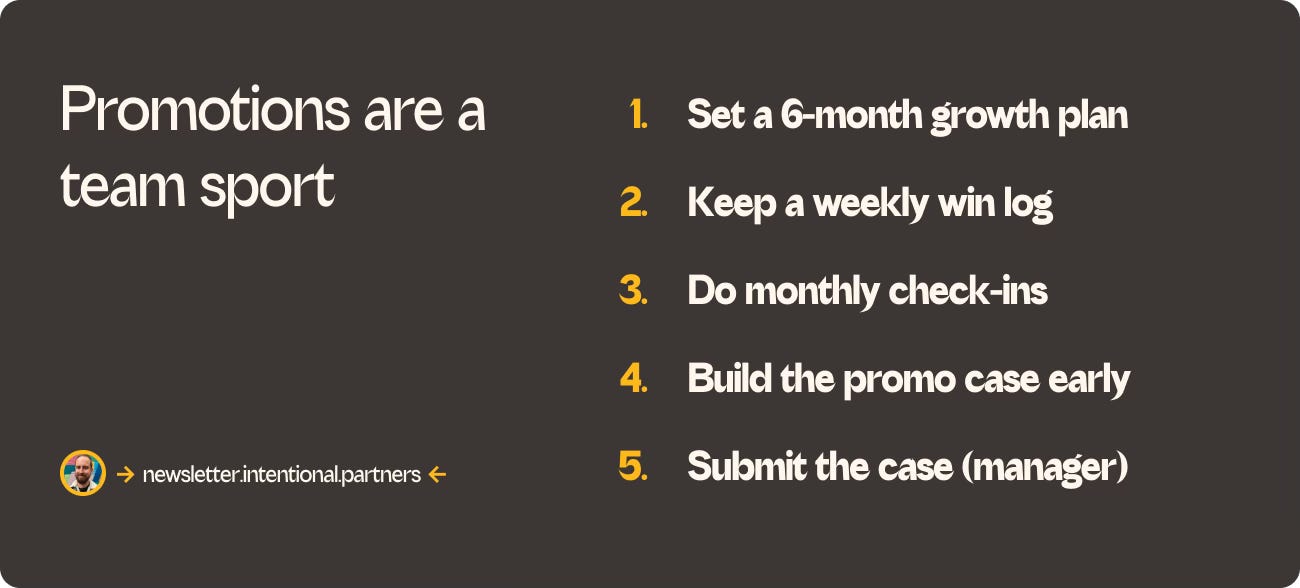
1. Set a 6-month growth plan
Start with a dedicated 1:1 to talk about longer-term goals and career development.
Managers: this is your opportunity to ask an important question to open the door and start aligning on expectations:
“Is a promotion something you’re hoping for or expecting over the next 6–12 months?”
If you’re the managee driving the conversation, you might like to follow that up with something like, although bear in mind this will likely require some thoughtful consideration from your manager before getting back with a clear answer:
“What would it take for us to feel confident submitting a case in six months?”
From there, define 2–3 focus areas that:
- Reflect attributes expected at the next level in your progression framework
- Close any current gaps or signal clear readiness
This gives both sides a shared understanding of what success looks like and creates a foundation for regular reflection.
2. Keep a weekly win log
A running brag doc that captures evidence of outcomes, output and key milestones throughout your work provides the backbone of this approach.
- Take 5 minutes at the end of each week to jot down wins
- Map them to the focus areas you agreed on in your growth plan
This becomes your source of truth over time and makes it easier to write your case later. And since you’re the one updating it, it positions you to drive the conversation with your manager.
3. Do monthly check-ins
Once a month, review the win log with your manager as part of your regular 1:1s. This helps:
- Stay aligned on the promotion trajectory and likelihood
- Surface wins or impact that might otherwise go unnoticed
- Avoid last-minute scrambling or misaligned expectations further down the line
It turns the process into an ongoing conversation, rather than a single point-in-time decision.
4. Build the promo case early
After a few monthly check-ins, assuming things are on a positive trajectory, start pulling together a draft promotion pack. Most companies at scale will have a template for this, but if not, here are some areas to include:
- Outcomes: consistent evidence of the positive impact you’ve driven on the business or customers in ways that reflect the level of depth or breadth required of the level you’re looking for promotion to.
- Outputs: consistent evidence of delivering at the pace and quality expected from the next level.
- Influence: evidence that you’ve built trust and support from some cross-functional stakeholders and senior leaders, who’d back your promotion decision.
If you’re the managee, you can offer to write a first draft for your manager to react to. Not as a demand, but as a thoughtful step to save time, build clarity and alignment.
5. Submit the case (manager)
Ultimately, your manager owns this step. But by laying the groundwork together, they’re better equipped to confidently and effectively advocate for you.
To recap—
Using AI as your case-building assistant
AI won’t get you promoted, but it can support you in doing the thinking work required to get there.
Here’s how to make it a true partner in your promotion journey:
Translate your growth plan into examples
Feed your progression framework into a prompt like:
“What kinds of work or impact would show I’m operating at this level?”
While this is always worth clarifying with your manager, this can help you define the kinds of evidence to collect each week.
Summarise your win log for check-ins
Each month, paste in your notes and ask:
“Summarise these wins into a clear impact report, grouped by the three growth areas.”
This helps focus check-ins on the evidence, positioning you and your manager as partners in spotting gaps and building up your case together over time.
Draft or stress-test your promotion case
Prompt it with:
“You’re on a promotion committee. Based on this evidence, what’s missing or unclear?”
or
“Write a concise, persuasive summary of this promotion case, focused on business impact, influence, and consistency.”
You can refine it later, but this helps get unstuck and spot weaknesses early.
Reducing the manager bottleneck
It’s worth saying: your manager might deeply want to support you, but many senior leaders juggle a huge range of responsibilities and may not have the capacity to make this their number one priority right now.
That’s why proactively building the case with them is one of the most powerful things you can do. It’s not about forcing their hand, it’s about partnering together to build a case you both feel aligned around.
You can help by:
- Keeping your growth plan and win log up to date
- Offering context on behind-the-scenes influence or cross-functional wins
- Drafting a first version of the case to make review easier
- Bringing questions and reflection to your check-ins, not just updates
Also, your manager may be thinking about the broader implications of your promotion, like:
- How will this person’s role or responsibilities evolve at the new level?
- What work will they step away from—and how will that be covered?
- How does this affect team structure? And can we actually accommodate a promotion to this level?
You don’t need all the answers, but offering some early thoughts shows maturity and forward-thinking.
Final thoughts: Build the case before you need it
Promotions aren’t granted. They’re earned, and clearly articulated. And that articulation doesn’t happen overnight.
By setting direction, logging wins, and creating regular space for feedback, you build the conditions for a strong case. And with AI as a tool, you can sharpen your story, stay organised, and reduce the friction in a process that often gets left too late.
This isn’t about going around your manager. It’s about meeting each other halfway, and building momentum together.
You’ve got more control than you might think.